Thursday, June 1, 2051


Astronautics (alternatively cosmonautics), is the theory and practice of navigation beyond the Earth's atmosphere. In other words, it is the science and technology of spaceflight.


Tamyria Osa studio time


Monday, November 20, 2017

Tuesday, September 16, 2014

Tap Tempo


This is plain as duck. You just connect it with your delay pedal's tap tempo input and go. Most delay pedals usually need three taps to get the tempo. Completely passive, no power needed. It consists of a mono output jack and a momentary footswitch in a really small box to fit in any rig.


Made for my pal Jim of L.D.M. Custom Workshop, who also provided the artwork!


Saturday, May 24, 2014

Kakofon

Here's my take on the famous Cacophonator, originally designed by Arthur Harrison.


I noticed the crazy sounds it would produce when shutting it off, so I added a voltage sag potentiometer to keep the voltage on lower levels. Also there's a second output, controlled by an on-off switch, as well as a passive two-potentiometer tone control.
Everything is housed into a plastic box with graphics printed on glossy paper.


Wednesday, May 21, 2014

last night my keys-man Alex borrowed me this:


Tascam Porta 03 mkII ministudio

the idea is to try and record electronic sounds
I've never used a 4-track before. Let'see how it goes...

Wednesday, May 7, 2014

I got myself an Akai MPX8 sample player!


As far as it goes it rides pretty well with a Korg Electribe ER-1 via midi.
The SD card slot does the job, but I think its a bit slow on loading the samples. I'll try a higher class card.

Monday, December 16, 2013

Rec & Play


This is a device that records and plays back wav files. It has all the controls a player and a recorder should have, plus an Input Gain, a Mono or Stereo input selector, an on/off switch for the Output and an SD card slot where the recordings are stored.


I ran onto this board while on ebay and thought of constructing this module. This circuit is mostly used on robotics. I should have known better before starting the project, because the whole thing proved to be a pain in the ass with all these debugging sessions. I transferred the buttons on the 1mm steel sheet faceplate, where I had applied a hand drawn label and multiple layers of lacquer.


The SD card feature is quite handy, because you can also store stuff from a computer and reproduce it.


Here's a close-up of the input and output switches.

Overall it's a useful device -if you don't have a sampler or something similar- but the sound quality is a bit poor and when in loop mode the pause between the ending and starting points is quite annoying and can set you off beat.


New Snare!

Just updated my drum set with this motherf*ckin' beauty:
It's a PDP Blackout 14"x6", 8 ply maple.
I changed the upper skin with an Evans Genera Dry and it rocks like hell!!

Monday, October 21, 2013

you will be my new year's present...
(click for more info)
2014 update: I got an Arturia Microbrute instead... ;-)

WSG Filter


My take on the famous WSG Filter. Originally designed by Ray Wilson (http://www.musicfromouterspace.com/) in his Weird Sound Generator. I found the schematics around the internet, but I needed to sync it with other stuff somehow, so I tried to figure out a way of adding an external controller and came up with this "External Control" input, where I plug a photo resistor soldered to a 3,5mm jack.


Fine, Coarse and Resonance controls as well as the aforementioned photo resistor input, that can be placed towards a flashing LED (of a tremolo or a drum machine or whatever) and make its wobbles in sync!


Soldered on veroboard and housed on 1,5mm metal sheet with laminated label.

Saturday, July 27, 2013

Christinoize


A simple, battery powered 4093 IC synth, with a photo resistor controlling one of the two oscillators, built-in speaker and headphone output, built specifically for my friend Christine to show my gratitude for her hospitality when I visited Nafplio!

video:

TAP Pre


I had it laying around and decided to rehouse it on a faceplate and put it on the my modular system. It's a Greek made booster by TAP, that is used mainly for boosting the signal of a bouzouki (as labelled on the original case pictured below).


Volume, High and Low controls. I left it intact. No bypass neither a power switch. All I did was moving the potentiometers and the input and output jacks, adding an LED and change it's power socket to the usual 2.1mm.

  
The original case side by side with the circuit's new suit! And the pcb, that seems a bit DIY made.


Anal Detonator


A true bypass looper. Can be used with no power supply, as it is only required for the LED indication. I made two of these for Kostas P. and John T., the guitarists of Speedblow.


Here are the guts, before soldering the LED and power socket. 


And that's a desktop version for my band Tamyria Osa. I've added input and output volume controls, as well as a feedback switch and a potentiometer for the feedback amount, turning it to a feedback looper.


Friday, July 26, 2013

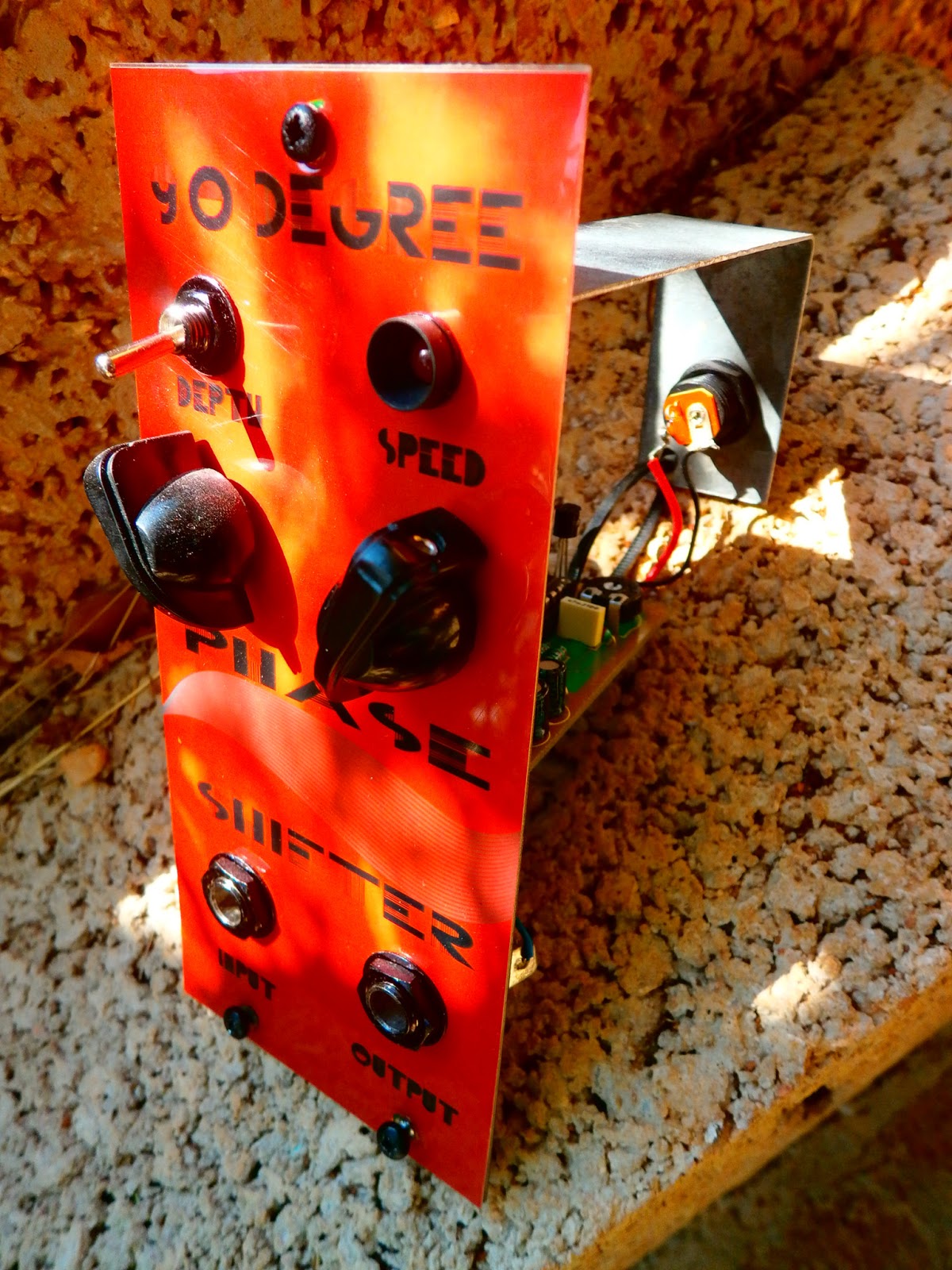
90 Degree Phase Shifter

 MXR 90 clone kit module, with a different approach on faceplate labeling. It was printed on photographic paper, laminated and placed on 1,5mm metal sheet.


Thursday, July 25, 2013

4093


Four oscillators based on the 4093 chip, inspired by Nicolas Collins' excellent book "Handmade Electronic Music". I added various caps on various places, controlled by the switches. There are also two outputs. The second one is controlled by an on/off switch for constant noise or the red momentary push button, for instant or more rhythmic playing.

video:

Tremor Control


Many knobs to teak! A tremolo effect featuring Smoothness, Space, Depth, Speed, Symmetry and a 3PDT switch to bypass the whole thing. 


Solid faceplate on stainless 2mm and galvanized back plate to mount the pcb and power input. 


Steptone Mother / Stepped Tone Generator


The desktop and module versions of the Stepped Tone Generator by Forrest M. Mims III.
My desktop version makes use of two 555 ICs whereas the module has a 556.


The yellow box was given as greeting on my nephew's name giving day and it was full of sweets! The knobs are salvaged by an old n broken hifi amplifier while the light thingy was a 0,50€ reading light.


It features the frequency and pulse width controls, as well as a switch that incorporates a photoresistor that can be driven by the LED above it. There's another potentiometer that does something and a push button bypassed with a switch that also do something, but I don't remember exactly what I have done in there!

ACTION! :


Aaaand that's my take on the legendary Atari Punk Console that went modular.


Frequency, Pulse Width, Volume and Power Switch, with a bright blue 5mm LED.


I'm planning on a modification for a CV input...


DIY-etched PCB, (using hydrochloric acid and perhydrol on the process), as designed by Worth Ekik (I wonder where his site has gone, so here's a link for the layout from get lofi.


Sim.Anal.Osc_


A very simple analogue, one transistor oscillator. Pitch, tune and power controls. The circuit is built on terminal strips - no pcb or solder was used. The faceplate looks so damn ugly...

Yes, she does!


Rack

Okay, so here's the wooden rack I'm going to fill with cheap, dirty and handmade modules. I only paid for the metal handles, since the wood was acquired from a discarded bookcase (Thanks Kostas P.!). I'm thinking of having a second one built by a professional carpenter, I'm sure he's going to do a much better job than this!